Santo Domingo, Dominican Republic
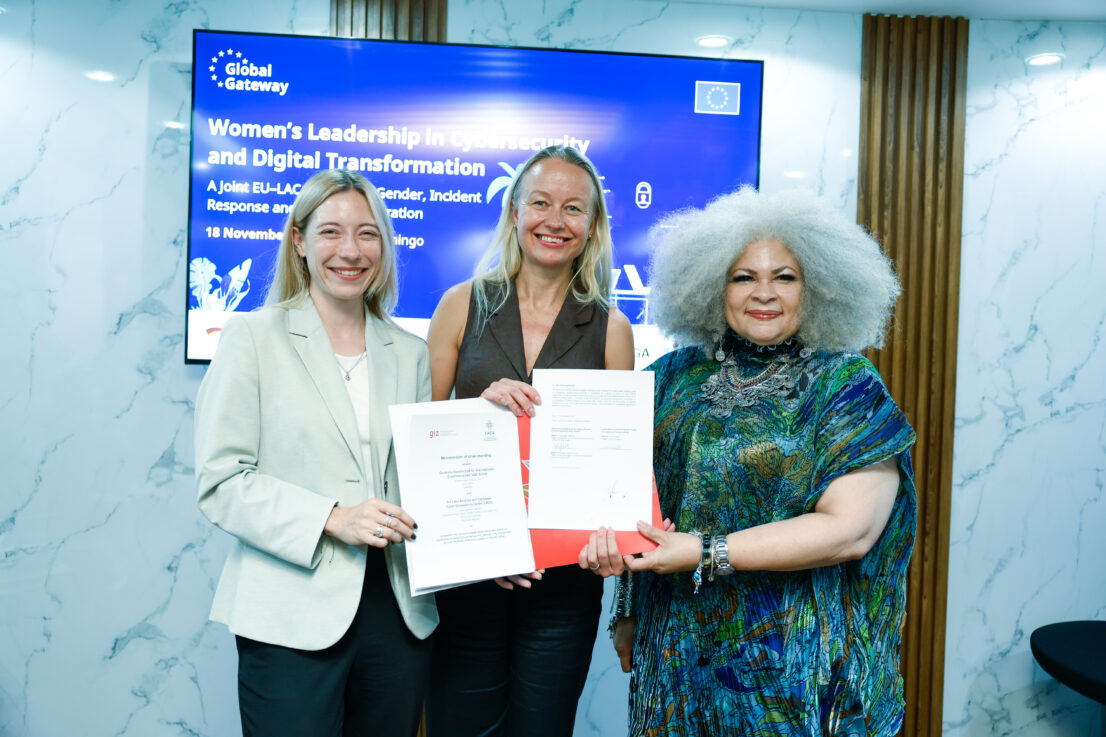
On 18 November 2026, the Deutsche Gesellschaft für Internationale Zusammenarbeit (GIZ) GmbH, through the EU-LAC Network of Women Leaders in Digital Policy under the EU-LAC Digital Alliance, and the Latin America and Caribbean Cyber Competence Centre (LAC4) signed a Memorandum of Understanding (MoU). The MoU establishes a framework for cooperation to strengthen women’s leadership and participation in cybersecurity and digital policymaking in Latin America, the Caribbean and Europe.
The partnership was formalised during a joint EU-LAC session on gender, incident response and digital cooperation, co-hosted by EU-LAC Digital Alliance partners as part of the CyberWeek@LAC4. The EU-LAC Digital Alliance initiative EU-LAC Cyber-SHIELD was also part of these joint efforts, supporting closer cooperation between the two regions on cyber incident preparedness and response.
“LAC4 is pleased to be included in the EU-LAC Network of Women Leaders in Digital Policy. It is a very natural and important collaboration, because we have long believed that building a stronger cybersecurity community relies on diversity and inclusivity, ensuring that women are not only part of the conversation, but also shaping the policies and decisions. Through our initiatives in the region, we have seen the talent, ambition and potential already present, and we are happy to join forces to create more opportunities and pathways for women to take leadership in cybersecurity.”
– Liina Areng, Director of LAC4
Why cybersecurity requires cooperation
Cyber incidents rarely stop at national borders. A disruption affecting a government agency, hospital, business or communications network can have consequences beyond the organization or country initially targeted. Yet countries and institutions may differ in their cybersecurity capabilities, resources and channels for sharing information. These differences can make it harder to identify threats, coordinate responses and learn from incidents.
Cooperation helps address these challenges. Governments and regional partners can exchange experience, strengthen technical and policy capacities, and build trusted relationships before a crisis occurs. Cybersecurity is not just a technical matter: effective response also depends on clear policies, skilled people, coordinated institutions and the ability to learn together. For Europe, Latin America and the Caribbean, this means connecting regional experience while recognizing the different contexts in which partners operate.

Why women’s leadership matters in cybersecurity
Cybersecurity also depends on who has the opportunity to shape its policies, institutions and responses. Women remain underrepresented in senior ICT decision-making: In 2025, women held only around one in five positions as information and communications technology ministers and regulators[1]. At the same time, the gender digital divide persists: in 2025, around 280 million more men than women used the internet worldwide[2].
These gaps are connected. If women have fewer opportunities to enter, remain and advance in cybersecurity, and less representation in the spaces where digital policies are designed, the sector risks missing experience and perspectives that can contribute to stronger, more inclusive decisions. Gender equality is therefore not separate from cybersecurity. It is part of building capable, representative and resilient digital ecosystems.
[1] ITU (2025). Stronger together: Why we created a global network of women digital leaders. International Telecommunication Union. https://www.itu.int/hub/2025/08/stronger-together-why-we-created-a-global-network-of-women-digital-leaders/
[2] ITU (2025). Facts and Figures 2025: The Gender Digital Divide. International Telecommunication Union. https://www.itu.int/itu-d/reports/statistics/2025/10/15/ff25-the-gender-digital-divide/
“Cybersecurity remains one of the least diverse professions in the digital world. Women hold barely one in four positions in the sector. This is not just a matter of fairness; it is a matter of security. A sector that leaves out half of its talent is less equipped to anticipate threats, less capable of understanding those affected by them, and less effective at responding to them.”
– Melvin Asin, Head of Cooperation, EU Delegation to the Dominican Republic
Addressing these gaps requires practical action: expanding access to cybersecurity skills and professional networks, creating opportunities for mentorship and peer learning, and ensuring that women can contribute to policy discussions and incident response. The partnership between GIZ and LAC4 provides a framework to explore cooperation in areas such as capacity-building, mentorship and policy engagement.
From agreement to action
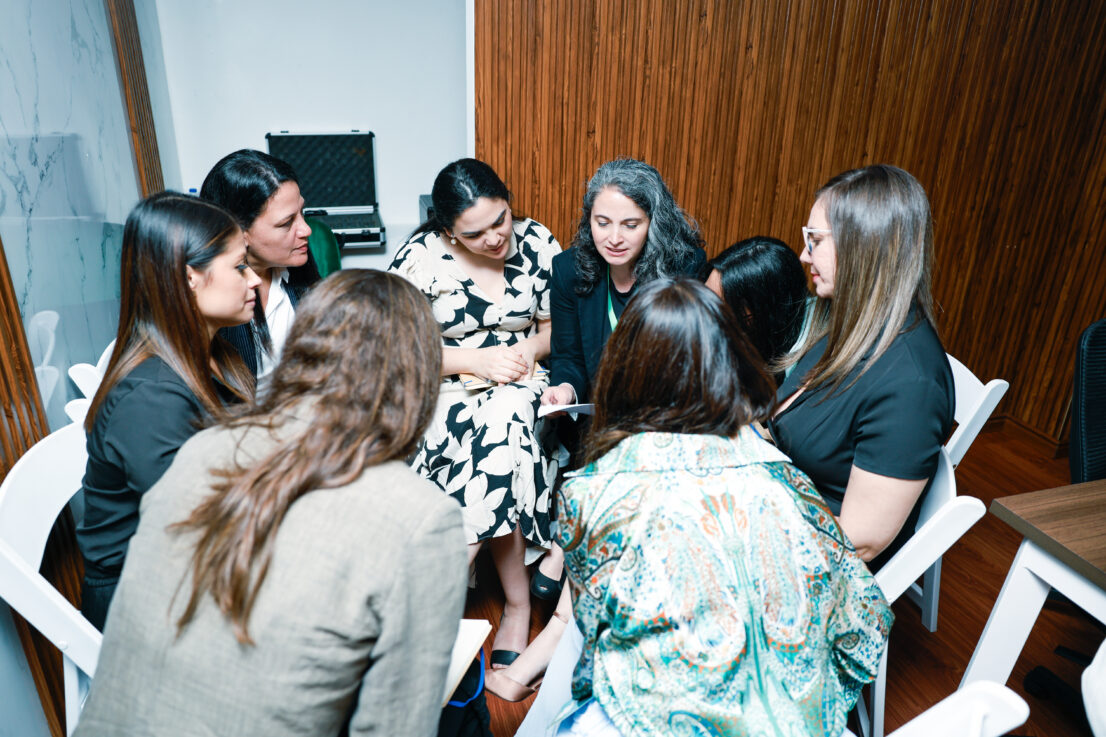
At the session, participants explored how to integrate gender perspectives into cybersecurity incident response, highlighting that networks matter because they connect people and exchange across institutions and disciplines. By linking the EU-LAC Network’s focus on women’s leadership in digital policy with LAC4’s regional cybersecurity expertise, the partnership aims to strengthen these connections across technical and policy communities, creating new pathways for women to become the cybersecurity professionals and decision-makers of tomorrow.
At the same time, the broader EU-LAC Digital Alliance, under the EU’s Global Gateway strategy, provides a framework for cooperation between Europe, Latin America and the Caribbean on digital priorities. The partnership between the Network and LAC4 brings a specific focus to that work: advancing women’s leadership and gender equality in cybersecurity.

Building a safer and more inclusive digital future requires diverse perspectives and meaningful participation. Through their partnership, LAC4 and the EU-LAC Network take an important step towards advancing gender equality in cybersecurity and recognising the vital role women’s voices, expertise and perspectives play in shaping digital policies and systems that work for everyone.
As Elodie Anthonioz, Country Representative of Expertise France in the Dominican Republic and Team Leader of EU-LAC CyberSHIELD, put it in her closing remarks: “Small rooms, big ideas”. A powerful reminder that meaningful change often begins with creating the space for diverse voices to come together.
The EU-LAC Network of Women Leaders in Digital Policy is an initiative of the EU-LAC Digital Alliance Policy Dialogues, co-funded by the European Union and the German Federal Ministry for Economic Cooperation and Development (BMZ). LAC4 is funded by the European Union. Both initiatives are part of the EU’s Global Gateway strategy.